| bogatyr Oct 24th 2013, 00:12, by Hirabutor | | | | Line 4: | Line 4: | | | | | | | | ===Etymology=== | | ===Etymology=== | | − | From {{etyl|ru|en}} {{l|ru|богатырь|tr=bogatýr'}}, from a Turkic language, probably {{etyl|zkz|en}}. Compare {{etyl|tr|-}} {{l/tr|bahadır}}, {{etyl|mn|-}} {{l|mn|баатар|tr=baatar}}, {{etyl|tt|-}} {{l|tt|баһадир|tr=bahadir}}. | + | From {{etyl|ru|en}} {{l|ru|богатырь|tr=bogatýr'}}, from a Turkic language, probably {{etyl|zkz|en}}. Compare {{etyl|tr|-}} {{l/tr|bahadır}}, {{etyl|mn|-}} {{l|mn|баатар|tr=baatar}}, {{etyl|tt|-}} {{l|tt|баһадир|tr=bahadir}}, from {{etyl|otk|tr}} {{term|otk|bagatur}} ("hero"). | | | | | | | | ===Noun=== | | ===Noun=== |
Latest revision as of 00:12, 24 October 2013 English[edit] Wikipedia Etymology[edit] From Russian богатырь (bogatýr'), from a Turkic language, probably Khazar. Compare Turkish bahadır, Mongolian баатар (baatar), Tatar баһадир (bahadir), from Old Turkic bagatur ("hero"). 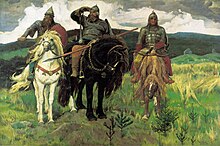 Three famous Russian bogatyrs - Dobrynya Nikitich, Ilya Muromets and Alyosha Popovich bogatyr (plural bogatyrs) - A medieval Russian heroic warrior, akin to Western European knight-errant.
- 2011, Rosamund Bartlett, Tolstoy: A Russian Life, Houghton Mifflin Harcourt, page 2 [1]:
- Later on, he [Tolstoy] was equated with Ilya Muromets, the most famous Russian bogatyr - a semi-mythical medieval warrior who lay at home on the brick stove until he was thirty-three - then went on to perform great feats defending the realm. Ilja Muromets is Russia's traditional symbol of physical and spiritual strength.
Translations[edit] medieval Russian heroic warrior See also[edit]
Etymology[edit] From a Turkic language, probably Khazar. See bogatyr for more. bogatyr m (plural bogatyrs) - a bogatyr

 |


